
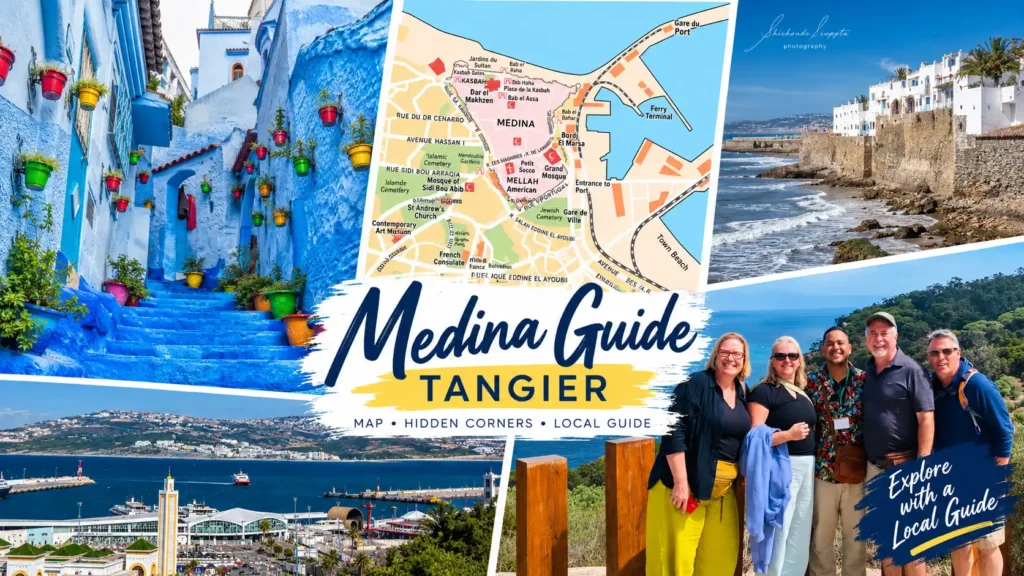
Navigating the old medina of Tangier can seem daunting, but understanding its structure and main gates helps visitors move confidently through this historic northern Morocco quarter. A medina guide explains the layout, key access points, general street patterns, and when hiring a licensed guide is recommended.
Key takeaways
- Tangier’s medina has several main historic gates for entry.
- The streets are narrow and winding, typical of Moroccan old towns.
- Landmarks and main streets aid in navigation.
- Hiring a licensed guide can enhance your understanding of the medina.
- Travel from Tangier to Chefchaouen is easily arranged.
What are the main gates to enter Tangier’s medina?
The medina of Tangier has several gates serving as its main entry points, each connecting the old city to newer neighborhoods. These gates mark the transition from modern Tangier to the compact medina full of alleys and traditional markets.
Visitors commonly enter through these historic gates, which provide fixed landmarks for orientation. The gates lead into streets lined with shops, historic buildings, and access to public squares. Knowing the closest gate to your accommodation or points of interest is useful for planning routes and recognizing your starting point for daily excursions.
How is the street layout inside the medina of Tangier?
Tangier’s medina streets are narrow, irregular, and often winding, typical of Moroccan old towns designed before motorized transport. The streets range from wider souk avenues to tight alleyways branching unpredictably.
The medina centers around public squares and market areas, from which many streets radiate. These focal points serve as natural navigation hubs to return to when exploring smaller lanes. While many streets are pedestrian-only, they feature signposts and hanging markers indicating directions toward main landmarks or gates.
The medina’s structure reflects layers of history and urban growth, making the road patterns complex but manageable with a basic mental map of main routes and squares.
How to avoid getting lost in Tangier’s medina?
Avoiding disorientation involves combining awareness of landmarks, sensible route planning, and use of available signage:
- Start from a recognizable spot such as near a main gate or plaza.
- Follow main streets rather than small side alleys initially.
- Note distinctive features like fountains, mosques, or markets as visual anchors.
- If unsure, ask locals—many merchants and residents are used to helping visitors.
- Carry a detailed map or use digital maps before entering, but be prepared for limited GPS signals in narrow streets.
- When time is limited, prioritize a defined itinerary focusing on key medina landmarks like the kasbah or central plazas.
When is hiring a licensed guide helpful in the medina?
A licensed guide is valuable for visitors seeking context, history, and assured orientation through the medina. Guides explain local culture, architecture, and hidden details not apparent to casual walkers.
For first-time travellers or those unfamiliar with Moroccan medinas, a guide prevents confusion and loss of time. Guides also facilitate interactions with vendors and can tailor routes to personal interests. While the medina is navigable alone, a local guide enhances safety, insight, and efficiency, particularly on limited schedules.
Planning your visit and transport advice from Tangier to Chefchaouen
The medina experience is often part of broader travel in northern Morocco, such as trips from Tangier to Chefchaouen in the Rif mountains. Chefchaouen is known for its distinctive blue medina, historic kasbah, and nearby natural spots like Ras el-Ma spring and the Spanish Mosque viewpoint.
For travel convenience, ToChefchaouen offers both shared and private day trips from Tangier to Chefchaouen. Shared trips provide a fixed schedule with round-trip transport in an air-conditioned vehicle, ideal for solo travellers and small groups. Private trips offer flexible departure times and pickup locations, suitable for families or larger parties. Choosing the right trip optimizes your day and allows adequate time to explore Chefchaouen’s medina and surroundings.
For detailed options and booking, consider all day trips from Tangier to Chefchaouen.
Conclusion
Tangier’s old medina is a historically rich and spatially intricate quarter, best approached with an understanding of its main gates and street layout. Navigation is facilitated by focusing on key landmarks, main streets, and entrances. While independent exploration is possible, a licensed guide enhances orientation, cultural understanding, and overall experience. Combining a visit to Tangier’s medina with a day trip to Chefchaouen provides a comprehensive northern Morocco itinerary.
Frequently Asked Questions
Is it easy to get lost in Tangier’s medina? Yes, the narrow and winding streets can confuse first-time visitors, but following main streets and landmarks reduces the risk of getting lost.
Are there street signs inside the medina? Yes, many streets have local signposts or hanging markers directing to gates and important places, though signs may not always be in multiple languages.
Can I explore Tangier’s medina without a guide? Yes, it is possible to explore independently using maps and paying attention to landmarks, but a licensed guide adds context and makes navigation easier.
Where do most visitors enter the medina? Most visitors enter through one of the main historic gates connecting the medina with other parts of Tangier, which serve as good starting points for exploration.
Does ToChefchaouen offer guided tours in Tangier’s medina? ToChefchaouen specializes in day trips from Tangier to Chefchaouen but does not provide medina walking tours in Tangier itself. For Chefchaouen trips, a guide is optional on private vehicles only.